What is Branch-to-Cloud Connectivity?
Branch-to-cloud connectivity is the secure networking infrastructure that connects enterprise locations such as branch offices and campuses to applications hosted in public cloud environments like AWS, Microsoft Azure, GCP and OCI.
As enterprises adopt hybrid and multi-cloud architectures, users and applications are increasingly distributed across many environments. Branch-to-cloud connectivity ensures that employees and systems can securely and reliably access cloud-hosted applications, data, and services from any enterprise location.
The key requirements for modern branch-to-cloud networking include:
Secure connectivity
Predictable application performance
Simplified operations
Support for hybrid and multi-cloud environments
Traditional Enterprise Approaches
Most enterprises today use one or more of the following technologies to achieve branch-to-cloud connectivity:
VPN and Internet-Based Connectivity
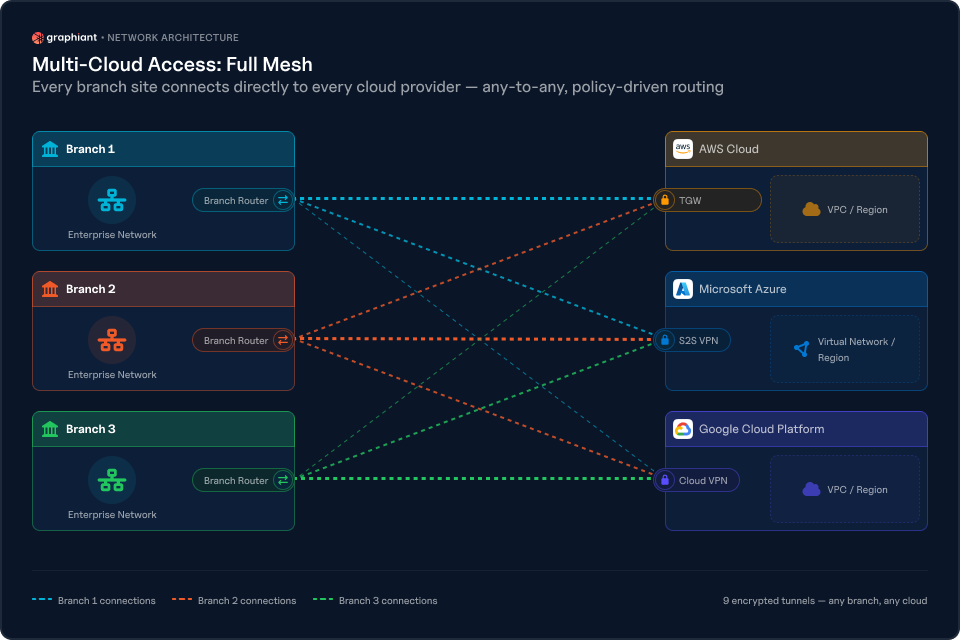
Many organizations connect branches to cloud environments using IPsec VPN tunnels over the public internet. This approach is fast to deploy.
However, internet-based VPNs often suffer from:
Packet loss and jitter
Operational complexity and tunnel sprawl
Limited visibility and policy control
Performance limitations and high cloud networking costs
As enterprises scale across multiple clouds and regions, managing hundreds or thousands of VPN tunnels becomes difficult and error-prone.
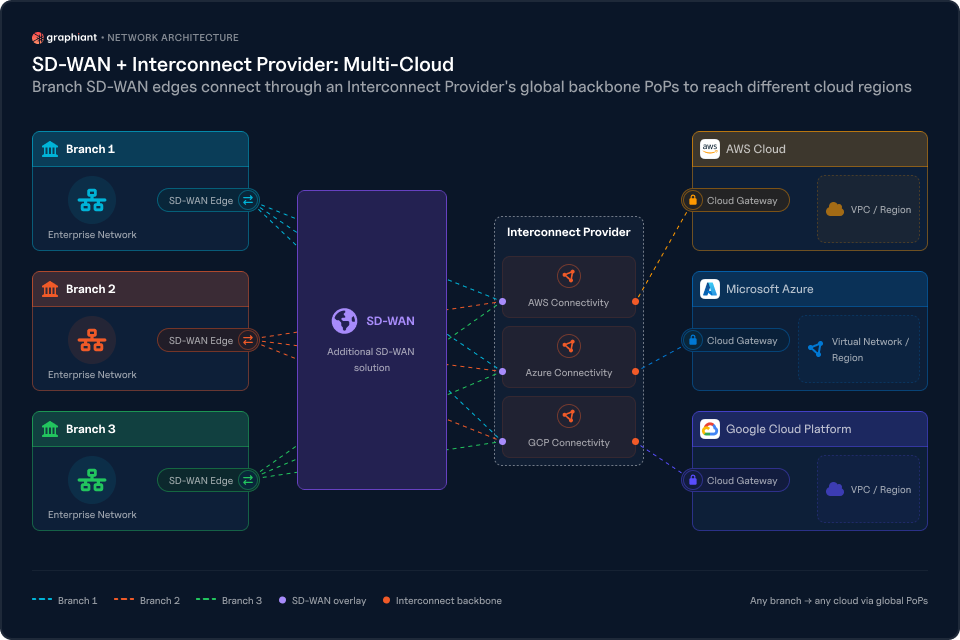
Interconnect Provider (Equinix, Megaport)
Interconnect providers like Equinix and Megaport provide cloud connectivity by allowing enterprises to connect their network from a data center into the provider’s fabric, and then establish on-demand, private connections to cloud services like AWS, Azure, GCP or OCI. Instead of a branch connecting directly to the cloud, traffic is backhauled to a DC location, where it enters the provider’s platform and is then routed privately into the cloud.
How Graphiant Solves Branch-to-Cloud Connectivity
Graphiant delivers branch-to-cloud connectivity as a network-as-a-service, connecting branches, clouds and users to a programmable private network fabric called the Graphiant Stateless Core.
Instead of managing IPsec tunnels, or cloud-specific gateways, you connect once to the platform, and Graphiant automatically handles routing, security, and traffic optimization all in a single solution. This enables secure, any-to-any connectivity with high performance and without manual tunnel configuration.
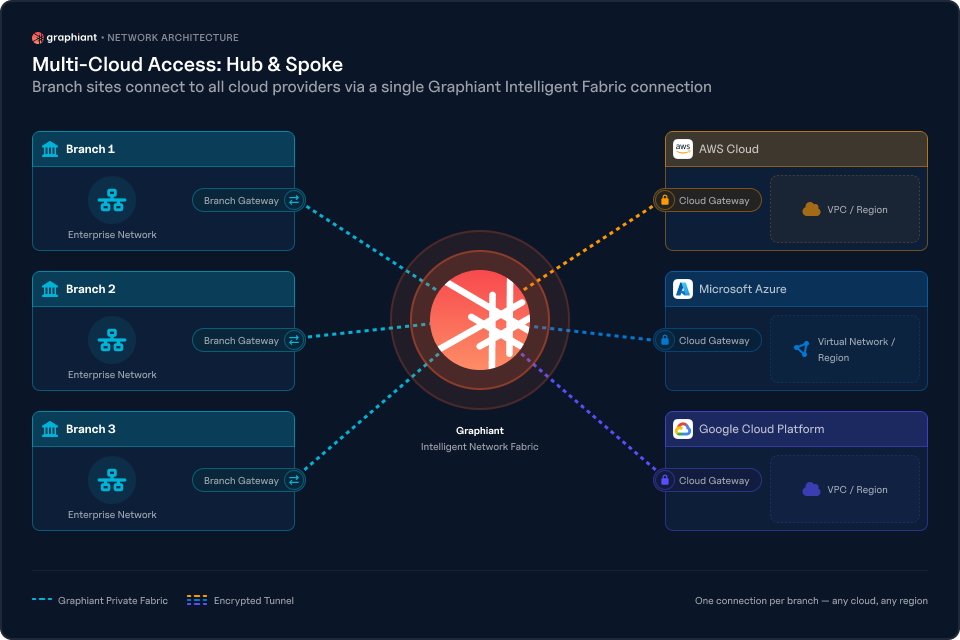
By abstracting networking into a service, Graphiant provides:
Simplified operations with centralized policy control
Fast, on-demand cloud connectivity across multiple providers
Reliable, private-network performance
Reduced cost and infrastructure complexity
This approach modernizes branch-to-cloud networking by combining the reliability of private networks with the flexibility and simplicity of cloud-native architecture.